


.svg)
Alpha ESS Battery Review: A Balanced Look for Australian Buyers
This Alpha ESS battery review covers everything Adelaide homeowners need to make an informed decision about one of the more widely sold battery brands in Australia. Alpha ESS was founded in China in 2012 and has grown into a significant presence in the Australian residential storage market, largely on the strength of its competitive pricing. That price point has made it attractive, but the brand's track record is mixed enough that it deserves a closer look before you commit.
Alpha ESS systems are installed across thousands of Australian homes, and many owners report solid day-to-day performance. At the same time, there have been documented concerns around warranty support, firmware reliability and long-term service availability that are worth understanding upfront.
This article covers the key Alpha ESS models and their specifications, real-world performance considerations, the honest pros and cons, and how these systems hold up for Adelaide homeowners dealing with SA Power Networks flexible export rules and some of the highest electricity prices in the country.
Alpha ESS Product Range: Key Models and Specifications
Alpha ESS produces several battery storage systems for the Australian market, ranging from compact entry-level units to larger three-phase systems suited to bigger homes and light commercial properties. All current residential models use lithium iron phosphate (LiFePO4) chemistry, which is a meaningful advantage over older lithium-ion chemistries. LiFePO4 cells are more thermally stable, less prone to degradation and carry a lower fire risk, making them a safer choice for residential battery storage in Australian conditions.
Before looking at individual models, it helps to understand two key terms. A battery's power output is measured in kilowatts (kW), which describes how much electricity it can deliver at any one moment. Its storage capacity is measured in kilowatt-hours (kWh), which describes how much total energy it holds. A 5 kW, 13.3 kWh battery can deliver up to 5 kW continuously and store enough energy to run a typical Adelaide home through most of an evening.
All Alpha ESS residential models sold in Australia hold Clean Energy Council (CEC) approval, which is a requirement for systems to be eligible under the Small-scale Renewable Energy Scheme (SRES) and for grid connection approval through SA Power Networks.
SMILE5: The Most Popular Residential Option
The SMILE5 series is Alpha ESS's flagship residential product and the model you are most likely to encounter in Adelaide homes. It combines a 5 kW hybrid inverter with a modular LiFePO4 battery stack, with capacity options ranging from 2.9 kWh up to 80 kWh depending on how many battery modules are connected. The most commonly installed configuration in Australian homes is the Alpha ESS SMILE5-13.3P, which provides 13.3 kWh of usable storage and retails for around $6,700 before installation costs.
The SMILE5 is a single-phase system, making it compatible with the vast majority of Adelaide suburban homes. The integrated hybrid inverter manages both solar input and battery charging in a single unit, which simplifies installation and reduces the number of components on the wall. Monitoring is handled through the AlphaCloud app via Wi-Fi, giving homeowners a clear view of solar generation, battery state of charge and household consumption in real time.
One practical feature worth noting is the automatic transfer switch (ATS) backup function. In the event of a grid outage, the SMILE5 can switch to backup power automatically, keeping selected circuits running without manual intervention. This is a genuine advantage for Adelaide households that have experienced outages during summer storm events.
The SMILE5 comes with a 5-year product warranty and a 10-year performance warranty, with Alpha ESS guaranteeing at least 70% capacity retention at the 10-year mark. That performance warranty is broadly in line with the industry standard, though it is shorter on the product side than some competitors offer.
SMILE B3 Plus and SMILE T10: Other Options Worth Knowing
The Alpha ESS SMILE B3 Plus is the brand's entry-level offering, with capacity options between 2.9 kWh and 8.2 kWh and a price range of roughly $3,500 to $6,500 before installation. It suits smaller Adelaide households with modest overnight energy needs, or homeowners who want to add battery storage incrementally and expand capacity later. The modular design means additional battery modules can be added as budgets allow.
For larger homes or light commercial applications, the Alpha ESS SMILE T10 is the three-phase option in the range. It supports storage from 10 kWh up to 30 kWh, making it relevant for Adelaide properties with higher energy demands or those running three-phase appliances. The T10's scalability also makes it a practical consideration for small Adelaide businesses looking to reduce daytime grid consumption and manage flexible export limits without oversizing from day one.
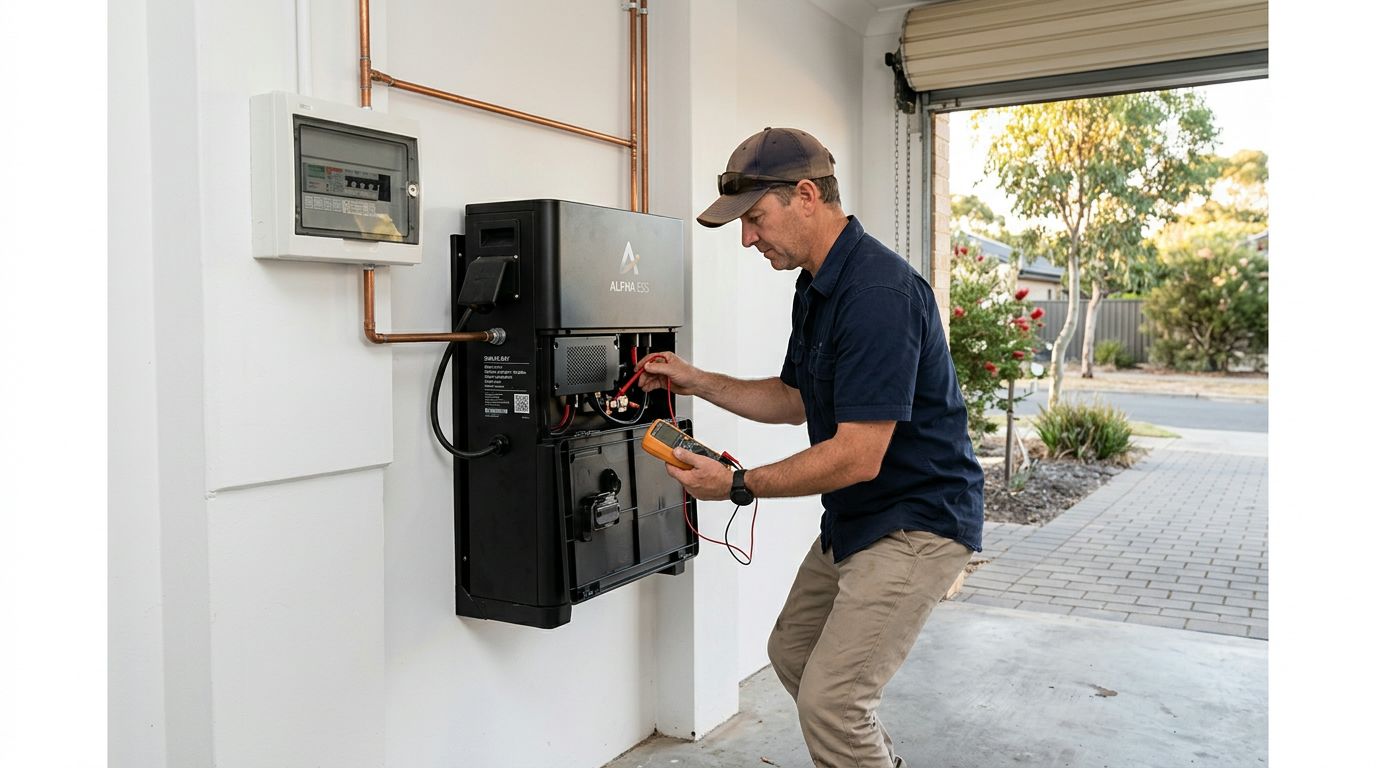
What Alpha ESS Gets Right and Where It Falls Short
Any honest Alpha ESS battery review has to go beyond the spec sheet. The brand has genuine strengths that explain its popularity in the Australian market, but there are also documented weaknesses that deserve a straight answer rather than a footnote.
The Strengths: Price, Chemistry and Scalability
The most obvious advantage is price. At roughly $1,025 per usable kWh installed, Alpha ESS sits in the mid-range of the Australian battery market, offering meaningfully more storage per dollar than premium brands like Tesla Powerwall or sonnen. For Adelaide homeowners who want a solid battery without paying a brand premium, that pricing is genuinely competitive.
The chemistry is another real positive. All current Alpha ESS residential models use LiFePO4 (lithium iron phosphate) cells, which contain no cobalt, carry a lower thermal risk than older lithium-ion chemistries and are rated for a longer cycle life. This is not a marketing claim unique to Alpha ESS, but it is a meaningful advantage over any battery still using NMC chemistry.
Scalability is a practical strength too. The modular design across the SMILE range means homeowners can start with a smaller capacity and add modules later as budgets allow, rather than committing to a large upfront purchase. The automatic transfer switch (ATS) backup function built into the SMILE5 is also worth noting. It switches the home to battery power automatically during a grid outage, with no manual intervention required, which is a practical feature rather than a gimmick.
Alpha ESS holds CEC approval across its residential range, is compatible with virtual power plant (VPP) programs available to South Australian battery owners, and maintains local offices in Adelaide and Sydney with Australian-based staff. That local presence matters for warranty and support escalations.
The Weaknesses: Installation Complexity and Support Concerns
The concerns around Alpha ESS are real and worth understanding before you buy. Installers have reported commissioning difficulties, particularly around unclear app choices during setup and unreliable Wi-Fi connectivity that can complicate the initial configuration process. Instruction quality has also drawn criticism, with some installers noting that documentation does not always match the firmware version on the unit being installed.
Technical support availability is a recurring issue. Alpha ESS's support hours are limited compared to some competitors, which can leave installers and homeowners waiting during time-sensitive fault situations. This is less of a concern during normal operation, but it matters when something goes wrong.
It is also worth noting that the Alpha Hybrid series has historically had surge capacity limitations that make it unsuitable for off-grid use. If you are looking for a battery to support a fully off-grid setup, the Alpha ESS SMILE range is not the right tool for that job.
Perhaps the most important caveat is that the quality of your experience with an Alpha ESS system depends heavily on who installs it. A well-configured system from an experienced, accredited installer will perform very differently from one that was rushed through commissioning. If you are weighing up your options, it is worth reading up on choosing the ideal home battery before making a final call.
Is Alpha ESS a Good Fit for Adelaide Homes?
Adelaide consistently records some of the highest residential electricity prices in Australia, with peak rates regularly exceeding 40 cents per kWh. That pricing environment improves the return on investment for any home battery, and Alpha ESS is no exception. Every kilowatt-hour of stored solar energy you use in the evening instead of drawing from the grid is worth more in Adelaide than it would be in most other Australian cities.
SA Power Networks' flexible export rules add another layer of relevance. Under the current framework, solar exports can be curtailed to zero during periods of high grid generation, which means excess solar energy produced by your panels may simply go to waste if you have no way to store it. A battery changes that equation entirely. Rather than losing that generation to curtailment, you store it and use it after dark. For a full explanation of how this works, see our guide to South Australia's flexible export rules.
The SMILE5's ATS backup function is particularly relevant for Adelaide households. South Australia has a well-documented history of grid instability, particularly during summer storm events and heatwaves. The ability to switch automatically to battery backup without manual intervention is a practical advantage that many Adelaide owners will actually use, not just a feature that sounds good on paper.
VPP eligibility is another consideration worth factoring in. Alpha ESS systems are compatible with several VPP programs, and dynamic tariff platforms like Amber Electric allow battery owners to earn additional income by charging when wholesale prices are low and discharging when they are high. For Adelaide homeowners with a correctly sized solar system, this can meaningfully improve the financial case for battery storage. Our review of how Amber Electric can help SA battery owners earn more covers this in detail.
One practical note on system sizing: a battery performs best when paired with a solar system large enough to reliably fill it on most days. For a 13.3 kWh Alpha ESS SMILE5, that typically means a solar array of at least 6.6 kW. Undersizing the panels relative to the battery is one of the more common mistakes Adelaide homeowners make, and it directly reduces the return you will see from the storage investment.
Alpha ESS vs the Competition: How It Compares
Alpha ESS sits in a crowded market, and understanding where it lands relative to key alternatives will help you make a more confident decision. Three brands come up most often in Adelaide conversations: Tesla Powerwall 3, GoodWe Lynx Home and Growatt.
The Tesla Powerwall 3 review tells a familiar story. Strong brand recognition, polished software, excellent installer support and a price to match. At roughly $16,000 to $18,000 installed for a 13.5 kWh system, the Powerwall 3 costs significantly more than a comparable Alpha ESS SMILE5-13.3P. What you get for that premium is a more refined commissioning experience, a longer product warranty and Tesla's well-resourced Australian support network. For buyers who want the most trouble-free installation and are comfortable paying for it, the Powerwall 3 is a legitimate choice.
GoodWe's Lynx Home series is a closer comparison. GoodWe has a strong inverter heritage and its battery systems are priced in a similar bracket to Alpha ESS. The Lynx Home benefits from GoodWe's established Australian distributor relationships and generally receives positive feedback from installers on commissioning reliability. If Alpha ESS's reported setup complexity is a concern for you, GoodWe is worth putting on your shortlist.
Growatt sits below Alpha ESS on price and is sometimes raised by buyers who have seen very low quotes. Growatt systems can represent reasonable value in straightforward installations, but the brand has less of a track record in the Australian residential storage market and support infrastructure is thinner. For most Adelaide homeowners, the modest price difference over Alpha ESS does not justify the additional uncertainty.
Alpha ESS represents solid value for budget-conscious buyers who choose an experienced, accredited installer. The LiFePO4 chemistry, CEC approval and local Australian presence are genuine positives. Buyers who prioritise brand support, polished software and a smoother commissioning process may find alternatives like the Powerwall 3 or GoodWe Lynx Home a better fit for their priorities.
FAQ: Alpha ESS Battery Questions Answered
Is Alpha ESS a good battery?
Alpha ESS is a competent battery brand for Australian residential use, particularly for buyers focused on value. The LiFePO4 chemistry is reliable, CEC approval is in place across the residential range and the SMILE5 performs well in day-to-day operation. The main caveats are around installer experience and support availability, both of which matter more with Alpha ESS than with some premium alternatives.
How long does an Alpha ESS battery last?
Alpha ESS guarantees at least 70% capacity retention at 10 years under its performance warranty, which is broadly in line with the industry standard for LiFePO4 batteries. In practice, a well-installed SMILE5 operating in typical Adelaide conditions should retain usable capacity well beyond that threshold. Cycle life ratings for LiFePO4 chemistry generally exceed 4,000 cycles, which translates to more than 10 years of daily use.
Where is Alpha ESS manufactured?
Alpha ESS is a Chinese company founded in 2012, and its batteries are manufactured in China. The brand has Australian offices in Adelaide and Sydney and holds CEC approval for its residential range, which is a requirement for grid connection and government incentive eligibility in Australia.
Is Alpha ESS compatible with solar panels?
Yes. The Alpha ESS SMILE5 includes a hybrid inverter that manages both solar input and battery charging in a single unit, making it compatible with most standard residential solar arrays. The SMILE B3 Plus is an AC-coupled option suited to homes that already have an existing solar inverter in place. Both configurations are compatible with SA Power Networks grid connection requirements.
Ready to Add Battery Storage to Your Adelaide Home?
Alpha ESS offers genuine value at a mid-range price point, uses safe LiFePO4 chemistry and suits Adelaide homeowners who want to store solar energy, reduce grid dependence and manage SA Power Networks flexible export limits. The SMILE5-13.3P at around $6,700 before installation is the most popular starting point, while the SMILE B3 Plus suits smaller homes and the SMILE T10 covers larger properties and light commercial use.
The honest takeaway from this review is that the battery is only part of the equation. An Alpha ESS system installed by an experienced, accredited team will perform very differently from one that was rushed through commissioning. Choosing the right installer matters as much as choosing the right product.
If you are ready to find out whether Alpha ESS or another battery brand is the right fit for your home, the team at Best Solar and Batteries can help. Get a free quote online or visit one of our Adelaide showrooms to talk through your options with someone who knows the local grid, the local tariffs and the products that actually perform in South Australian conditions.


