


.svg)
What Is a Hybrid Inverter?
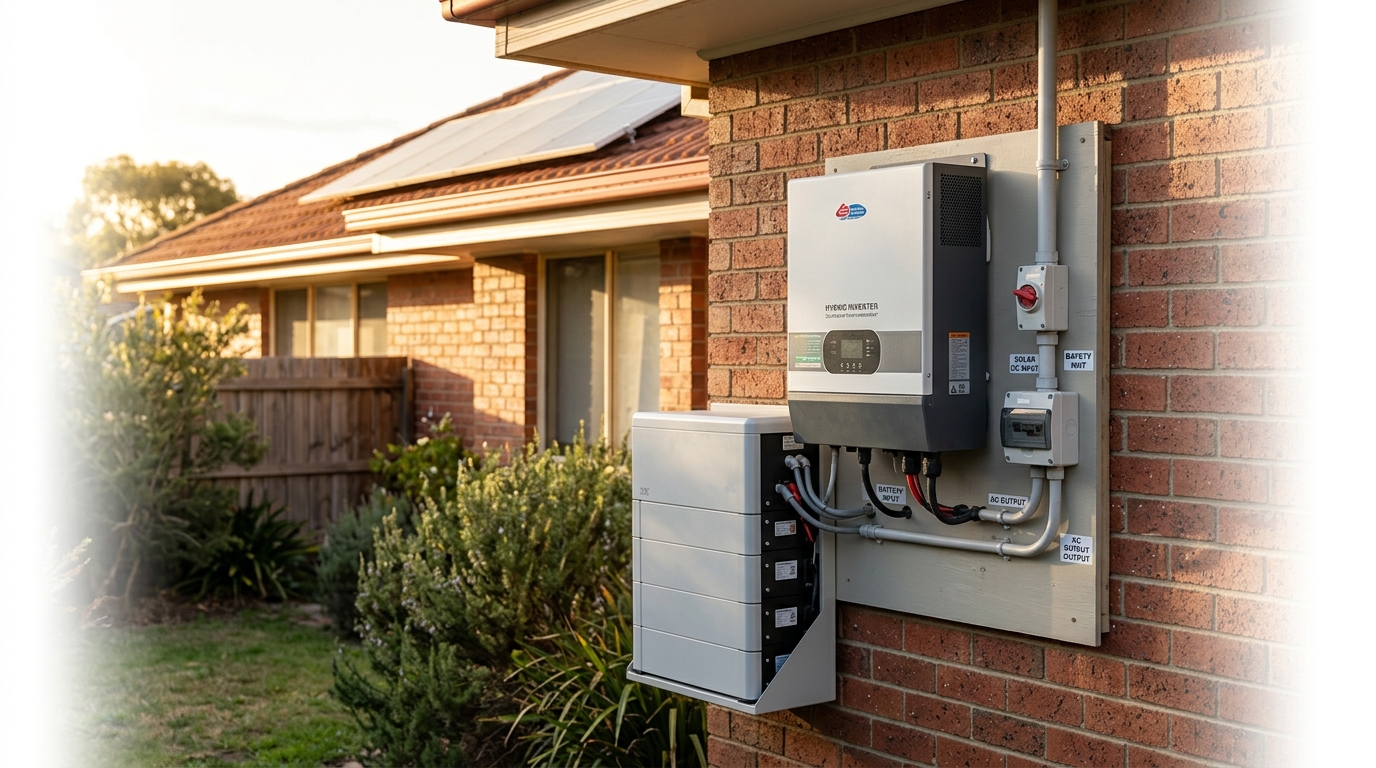
A hybrid inverter is an all-in-one device that combines the functions of a solar inverter and a battery inverter into a single unit. Standard solar inverters do one job: they convert the direct current (DC) electricity produced by your solar panels into the alternating current (AC) electricity your home actually uses. A hybrid inverter does that, and also manages the charging and discharging of a connected battery system.
Think of it as the brain of a modern solar and battery setup. It monitors how much solar power your panels are generating, how much your household is consuming at any given moment, and decides in real time whether to power your home directly, charge the battery, or send surplus energy back to the grid. When the sun goes down, it draws stored energy from the battery to keep your lights and appliances running.
For Adelaide homeowners considering battery storage now or in the future, a hybrid inverter is worth understanding from the outset. If you want more background on how battery storage works alongside solar, our guide to solar batteries for your home is a good place to start.
How Does a Hybrid Inverter Work?
A hybrid inverter manages the flow of electricity between four sources: your solar panels, your battery, the grid, and your home. To do this accurately, most systems use an external energy meter, often called a CT (current transformer) meter, which clips onto your main switchboard wiring. This meter measures your household's real-time consumption and feeds that data back to the inverter so it can direct power where it is needed most.
The Sungrow SH Series Hybrid Inverter, available in 5 kW and 10 kW models, is one of the most widely installed hybrid inverters in Australian homes. It is compatible with multiple battery brands and is designed to operate across all four of the main modes described below, making it a practical choice for grid-connected Adelaide households.
Grid-Tie Mode vs Hybrid Mode
In grid-tie mode, a hybrid inverter behaves like a standard solar inverter. It converts your solar power to AC, supplies your home first, and exports any surplus to the grid for a feed-in tariff credit. There is no battery involved, and the inverter makes no attempt to store energy. This mode is useful if you have installed a hybrid inverter but are not yet ready to add a battery.
Hybrid mode is where the real benefit emerges. Instead of exporting surplus solar straight to the grid, the inverter prioritises charging your battery first. Once the battery is full, any remaining surplus is exported. In the evening, the inverter draws from the battery before pulling from the grid, which reduces the amount of expensive peak-rate electricity you buy. For most Adelaide households, hybrid mode is the default setting because it maximises self-consumption and reduces reliance on the grid, particularly given South Australia's relatively high electricity rates.
The trade-off is that hybrid mode requires a battery to deliver its full benefit. Running a hybrid inverter in grid-tie mode without a battery is perfectly functional, but you are paying a premium for hardware you are not yet using.
Backup Power During Blackouts
Most hybrid inverters include a backup power function that automatically switches your home to battery power during a grid outage. This switchover typically happens within milliseconds, fast enough that most appliances do not notice the interruption. However, backup power does not usually cover your entire home by default. Your switchboard generally needs to be modified to create a dedicated backup circuit, isolating the appliances you want protected, such as the fridge, lights, and phone chargers, from heavy loads like air conditioners or electric ovens that would drain a battery quickly.
The amount of backup time you get depends entirely on your battery capacity and what you have connected to the backup circuit. A 10 kWh battery powering essential loads might last through a full night, while the same battery running a large household without any load management could be depleted in a few hours. For Adelaide homeowners who remember the 2016 statewide blackout, this backup capability is a genuine drawcard. South Australia's grid has improved significantly since then, but the memory of that event has made many households conscious of grid reliability, and backup-capable hybrid inverters offer a practical layer of resilience.
It is worth noting that most hybrid inverters sold in Australia are designed for grid-connected homes. They are not intended as permanent off-grid solutions, and their backup capacity reflects that. If you need a true off-grid system, that requires a different design approach altogether.
Hybrid Inverter vs Standard Solar Inverter: What's the Difference?
A standard string solar inverter does one job well: it converts DC power from your panels into AC power for your home, and sends any surplus to the grid for a feed-in tariff credit. That is where its role ends. It has no way to store energy, so any solar power your home cannot use in the moment is exported, typically at a low feed-in rate of around 5 to 8 cents per kWh in South Australia.
A hybrid inverter does all of that, and also manages a connected battery. Instead of sending every kilowatt of surplus solar to the grid, it charges the battery first and exports only what remains. In the evening, it draws from the battery before pulling from the grid, reducing your reliance on expensive peak-rate electricity. The difference is not just technical, it is financial.
A third option worth knowing about is microinverters, which are small inverters mounted behind each individual panel rather than a single unit on the wall. If you want to understand how that approach compares to a standard string setup, our article on microinverters versus string inverters covers the trade-offs in detail. Hybrid inverters, however, are a separate category designed specifically around battery integration.
In terms of upfront cost, a 5 kW standard string inverter typically sits in the $1,000 to $1,200 range before installation. A comparable 5 kW hybrid inverter generally costs $1,400 to $2,000, with premium models like the Fronius GEN24 Plus, which supports both battery storage and backup power, sitting toward the higher end of that range.
The Cost Difference Explained
Hybrid inverters cost more because they contain significantly more hardware. Alongside the standard solar conversion circuitry, they include a built-in battery charger, battery management electronics, and more complex firmware to coordinate power flows across multiple sources simultaneously. That additional engineering has a real cost, and it shows up in the price.
The premium of roughly 30 to 40% over a standard inverter is often justified if you plan to add a battery within the next few years. The alternative, installing a standard inverter now and retrofitting a separate battery inverter later, typically costs more in total. You pay for a second inverter, additional installation labour, and potentially new switchboard work to integrate the two systems. Choosing a hybrid inverter from the start avoids that duplication and leaves your system ready to accept a battery the moment you decide to add one.
Do You Need a Hybrid Inverter for Your Adelaide Home?
The honest answer depends on what you are planning to do with your solar system, and over what timeframe. There is no single right answer, but there are three scenarios that cover most Adelaide households.
If you are installing solar and a battery at the same time, a hybrid inverter is the natural choice. It handles both functions in a single unit, avoids the cost of a separate battery inverter, and simplifies the overall system design. This is the most cost-effective path for anyone who has already decided they want storage.
If you are installing solar now but expect to add a battery within the next two or three years, a hybrid inverter is still worth the upfront premium. It future-proofs your system so that adding residential battery storage later is straightforward, with no need to replace the inverter or reconfigure your switchboard. The cost of retrofitting a separate battery inverter to an existing standard inverter setup almost always exceeds the price difference you would have paid upfront.
If you have no plans to add a battery, a standard string inverter is sufficient and the cheaper option. There is no point paying for battery management hardware you will never use. A quality standard inverter will serve a battery-free solar system reliably for 10 or more years.
Adelaide's electricity prices are among the highest in Australia, which strengthens the case for battery storage generally. Feed-in tariff rates in South Australia have fallen significantly over the past few years, meaning the value of exporting surplus solar to the grid is much lower than it once was. Storing that energy and using it yourself in the evening, when grid electricity costs 35 to 45 cents per kWh, delivers a far better return than exporting it for 5 to 8 cents. South Australia's Virtual Power Plant schemes, which allow battery owners to earn additional income by sharing stored energy with the grid during peak demand events, also favour households with hybrid-ready systems.
Flexible Exports and SA Power Networks
SA Power Networks has introduced flexible export limits that can reduce or completely cut off a home's solar export to the grid at certain times of day, particularly during periods of high solar generation across the network. For households with a standard inverter and no battery, this means solar power that your home cannot use in real time is simply wasted rather than exported.
A hybrid inverter paired with a battery changes that equation. Instead of losing curtailed solar energy, the inverter redirects it into the battery for use later in the day. This makes a hybrid setup particularly valuable for Adelaide households affected by flexible export rules, which increasingly applies to new solar installations across the metropolitan area. Rather than watching your system throttle back on a sunny afternoon, you capture that energy and use it when it counts most, during the evening peak when grid electricity is at its most expensive.
Ready to Add a Hybrid Inverter to Your Solar System?
A hybrid inverter is the most versatile inverter choice for Adelaide homeowners who want battery storage now or in the future. It handles blackout backup, maximises self-consumption, and positions your home well for SA Power Networks' flexible export rules. Whether you are starting fresh or planning to add a battery down the track, getting the inverter choice right from the start saves money and avoids unnecessary retrofitting later.
The Best Solar & Batteries team services all Adelaide suburbs and can assess your roof layout, energy usage, and budget to recommend the right system for your home. There is no one-size-fits-all answer, and a free assessment takes the guesswork out of the decision. To book yours, get a free solar quote and one of our local advisers will be in touch.
Frequently Asked Questions
What is a hybrid inverter?
A hybrid inverter is an all-in-one unit that combines a solar inverter and a battery inverter in a single device. It converts DC power from your solar panels into AC power for use in your home, while simultaneously managing the charging and discharging of a connected battery. This makes it the most straightforward way to run a solar and battery system together.
What is the difference between a normal inverter and a hybrid inverter?
A standard solar inverter can only convert solar power for use in your home and export any surplus to the grid, while a hybrid inverter can also charge and discharge a battery. Hybrid inverters typically cost around 30 to 40% more than a comparable standard inverter, but they future-proof your system so you can add a battery at any time without replacing your inverter.
What are the disadvantages of a hybrid solar inverter?
The main drawbacks are a higher upfront cost compared to a standard inverter, and the fact that enabling backup power during a blackout often requires switchboard modifications, which adds to the installation cost. Not all hybrid inverters are designed for permanent off-grid use, so if you want to go fully off-grid, you need to confirm the model is rated for that purpose. For most Adelaide homeowners who plan to add a battery, these are manageable trade-offs that pay off over time.
Do I need a hybrid inverter to add a battery?
No, you do not always need a hybrid inverter to add a battery, but it is usually the most cost-effective and straightforward option. Some batteries include their own built-in inverter and can connect directly to an existing standard solar inverter. The Tesla Powerwall 3 is a good example of this approach. For most other battery systems, however, a hybrid inverter simplifies the installation and reduces overall cost by eliminating the need for a separate battery inverter.


