


.svg)
Which Is the Best Solar Battery in Australia for SA Homes in 2026?
South Australian households are paying some of the highest electricity prices in the country, yet feed-in tariffs have dropped so low that exporting surplus solar energy barely makes a dent in your bill. Finding the best solar battery in Australia for your home is no longer just a nice-to-have. For SA homeowners, it is quickly becoming the most practical way to get real value from a rooftop solar system.
This article compares three of the most popular home batteries available in 2026: the Tesla Powerwall 3, the Alpha ESS SMILE-B3 Plus and the GoodWe Lynx Home F Series. We have assessed each one across four criteria that matter most to Adelaide homeowners: overall value for money, real-world performance, backup capability during blackouts and suitability for South Australian conditions.
By the end, you will know which battery suits your home, your budget and your energy goals.
What to Look for Before Choosing a Home Battery in South Australia
Before comparing specific brands, it helps to understand the key numbers and features that separate a good battery investment from a disappointing one. Not all batteries are equal, and the right choice depends on how your home uses energy, whether you already have solar and what you need the battery to do during a blackout.
Here are the main factors to weigh up when investing in residential battery storage for an SA home.
Usable capacity (kWh): This is how much energy the battery can actually store and use. Kilowatt-hours (kWh) measure stored energy, the same unit you see on your electricity bill. A typical Adelaide household uses 15 to 20 kWh per day, so a 10 kWh battery might cover your evening and overnight needs but will not replace grid power entirely.
Continuous power output (kW): Kilowatts (kW) measure the rate at which the battery can deliver power at any given moment. A battery with a high kWh capacity but a low kW output may struggle to run multiple appliances at once. Think of kWh as the size of a water tank and kW as the size of the tap.
Round-trip efficiency: This tells you how much of the energy you put into the battery you actually get back out. A battery with 90% round-trip efficiency loses 10% of every kWh stored. Over years of daily cycling, that adds up.
Warranty length and cycle life: Most quality home batteries carry a 10-year warranty. Check whether the warranty guarantees a minimum capacity at end of term, typically 70% of original capacity, as this tells you how the battery will perform long-term.
Inverter compatibility: Some batteries include an integrated hybrid inverter, while others are designed to work alongside your existing solar inverter. If you already have a string inverter, you need a battery that is compatible with it, or you will face additional replacement costs.
Backup Power: Whole-Home vs Critical Circuits
Not all batteries provide the same level of protection during a blackout. Whole-home backup keeps every circuit in your house running when the grid goes down, including your air conditioner, oven and hot water system. Critical-circuit backup, by contrast, only powers a selected group of appliances, typically lights, a fridge and a few power points.
For Adelaide homeowners, this distinction matters. SA's grid is vulnerable to summer storm outages and heatwave-related demand spikes, and a blackout during a 40-degree day without air conditioning is a genuine health risk. If backup reliability is a priority, you need a battery that supports whole-home backup and has sufficient power output to run your most demanding appliances simultaneously. The Tesla Powerwall 3, for example, delivers 11.5 kW of continuous output, which is enough to run a ducted air conditioner alongside other household loads.
SA Power Networks Flexible Exports and Battery Storage
SA Power Networks has introduced flexible export limits that can cap how much solar energy your system is allowed to send to the grid at any given time. During peak periods, your export limit may be reduced to zero, meaning surplus solar generation is simply wasted if you have no battery to store it.
This makes battery storage significantly more attractive for SA homeowners. Rather than losing that excess generation, a battery captures it for use in the evening when grid electricity is most expensive. Understanding the SA Power Networks flexible export rules is an important step before sizing your battery, as the right system can be configured to maximise self-consumption and minimise the impact of export restrictions on your returns.
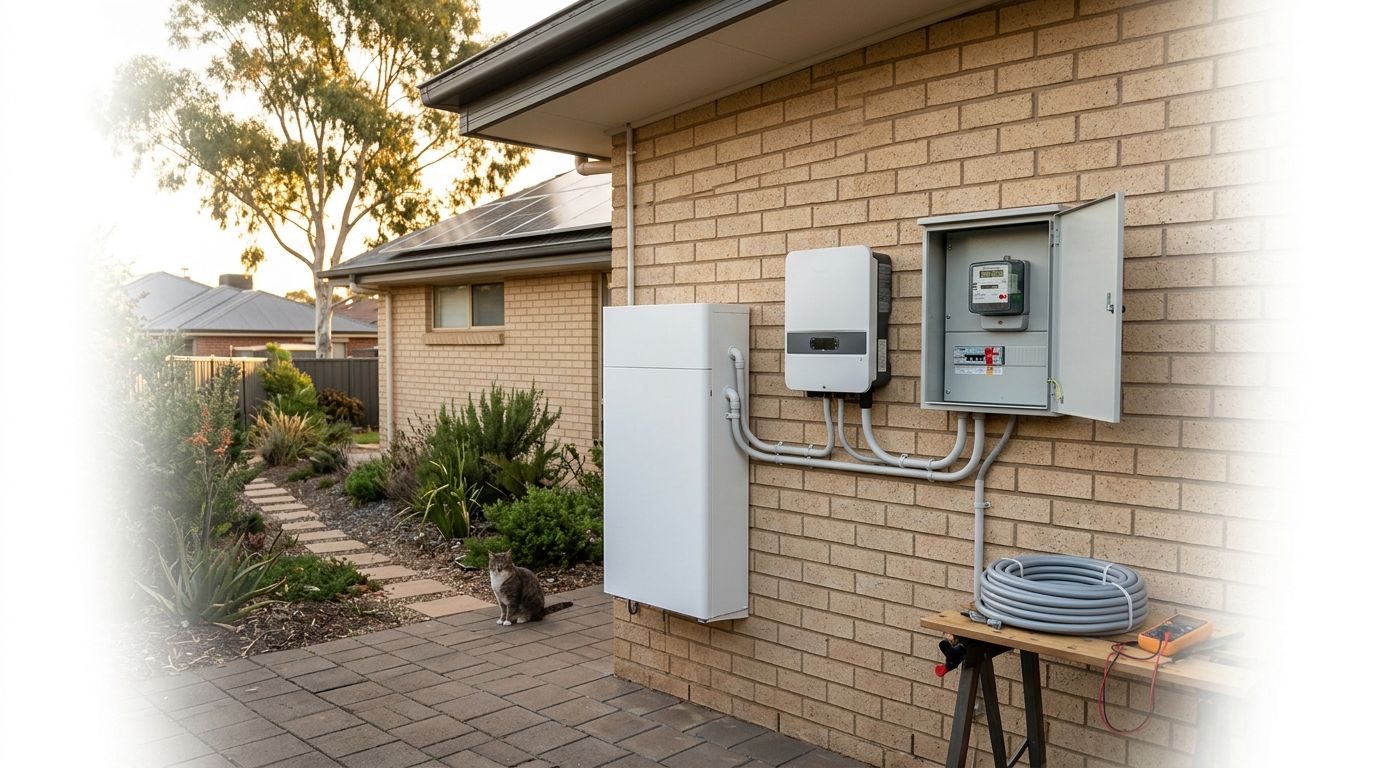
Tesla Powerwall 3 vs Alpha ESS vs GoodWe: Head-to-Head Comparison
The table below gives you a quick snapshot of how these three batteries compare across the specs that matter most for an SA home. Prices are approximate installed costs in Adelaide and will vary depending on your existing system, switchboard condition and installer.
| Specification | Tesla Powerwall 3 | Alpha ESS SMILE-B3 Plus | GoodWe Lynx Home F Series |
|---|---|---|---|
| Usable capacity | 13.5 kWh | 5.7 kWh to 11.4 kWh | 6.6 kWh to 9.9 kWh |
| Continuous power output | 11.5 kW | Up to 5 kW | Up to 5 kW |
| Round-trip efficiency | 97.5% | ~90% | ~97% |
| Backup type | Whole-home | Varies by configuration | Essential circuits (most models) |
| Warranty | 10 years | 10 years | 10 years |
| Approx. installed price | $14,000 to $16,000 | $8,000 to $11,000 | $7,000 to $10,000 |
Tesla Powerwall 3: Premium All-in-One Performance
The Tesla Powerwall 3 is the most capable home battery on this list by a clear margin. Its 13.5 kWh of usable capacity is paired with an integrated 11.5 kW hybrid inverter, meaning you get a complete solar and battery management system in a single unit. That continuous power output is high enough to run a ducted reverse-cycle air conditioner, a hot water system and everyday appliances at the same time, which is exactly what you need during a South Australian summer blackout.
Round-trip efficiency sits at 97.5%, which is among the best available in any home battery. The 10-year warranty is standard for the category, and the Tesla app gives you detailed real-time monitoring and remote control. Installation is clean and straightforward because there is no separate inverter to mount alongside it.
The trade-offs are real, though. At $14,000 to $16,000 installed, the Powerwall 3 is the most expensive option here. Capacity is fixed at 13.5 kWh, so you cannot add a second unit to expand storage without significant additional cost. You also need a Tesla-certified installer, which limits your choice of tradesperson. For a deeper look at performance and real-world results, read our full Tesla Powerwall 3 review.
Alpha ESS: Modular Flexibility at a Mid-Range Price
The Alpha ESS SMILE-B3 Plus takes a different approach. Rather than locking you into a fixed capacity, it starts at 5.7 kWh and can be expanded to 11.4 kWh by adding battery modules as your budget or energy needs grow. This modular design makes it a practical choice for homeowners who want to start smaller and scale up later, or who are not yet sure how much storage they actually need.
Compatibility is another strength. The SMILE-B3 Plus works alongside most existing string inverters, so if you already have a quality solar inverter on your roof, you may not need to replace it. Installed costs typically fall between $8,000 and $11,000 depending on the configuration, making it noticeably more affordable per kWh than the Powerwall 3. Alpha ESS also has a solid Australian support network, which matters for warranty claims and ongoing service.
The honest trade-off is that backup capability varies by model and configuration. Not all Alpha ESS setups offer whole-home backup, so you need to confirm this with your installer before committing. Brand recognition is also lower than Tesla, which can affect resale perception even if the hardware performs well. For a full breakdown of specs and real-world performance, see our Alpha ESS battery review.
GoodWe: Value-Focused Performance for Budget-Conscious Buyers
The GoodWe Lynx Home F Series offers 6.6 kWh to 9.9 kWh of usable storage and pairs neatly with GoodWe's own hybrid inverter range, making it a tidy all-in-one option for homeowners doing a combined solar-plus-battery install. Round-trip efficiency is competitive at around 97%, and the GoodWe monitoring app gives you clear visibility over your system's daily performance.
Installed prices typically sit between $7,000 and $10,000, making GoodWe the most accessible of the three on upfront cost. The price per kWh of storage is genuinely competitive, and GoodWe inverters have a strong track record in the Australian market. If you already have a compatible GoodWe inverter, adding the Lynx battery can be a particularly cost-effective upgrade.
The main limitation is backup capability. On most GoodWe configurations, backup power is restricted to essential circuits rather than the whole home, so your ducted air conditioner is unlikely to run during a grid outage. The overall product feel is also less premium than the Powerwall 3, which may matter to some buyers. For a closer look at how GoodWe stacks up, check out our GoodWe inverters and batteries review.
Which Battery Is the Best Fit for Your SA Home?
There is no single best solar battery in Australia for every household. The right choice depends on what you need the battery to do, how much you want to spend and whether you plan to expand your system down the track. Here are three buyer profiles that cover most SA homeowners.
You want the best backup and are happy to pay for it. If keeping your whole home running during a blackout is the priority, the Tesla Powerwall 3 is the clear choice. Its 11.5 kW continuous output handles heavy loads that other batteries cannot, and the single-unit install is clean and reliable. At $14,000 to $16,000 installed, it is a significant investment, but for families with medical equipment, young children or simply a low tolerance for summer blackouts, the premium is justified.
You want flexibility and good value, with room to grow. The Alpha ESS SMILE-B3 Plus suits homeowners who want a quality battery now but may want to add capacity later. Starting at 5.7 kWh and expandable to 11.4 kWh, it fits a range of budgets and works with most existing inverters. If you are not ready to commit to a full 13.5 kWh system, this is a sensible way to get started without overspending.
You want solid performance at the lowest upfront cost. The GoodWe Lynx Home F Series is the pick for budget-conscious buyers, particularly those doing a new solar-plus-battery install or already running a compatible GoodWe inverter. At $7,000 to $10,000 installed, it delivers reliable daily storage at a price that makes the numbers work for more households.
Whichever battery you choose, the federal Cheaper Home Batteries Program, which launched in 2025, can meaningfully reduce your upfront cost. Eligible SA households can access a subsidy that brings all three of these options closer to reach. The rebate amount varies based on battery capacity, so it is worth confirming your eligibility before you get quotes. Combined with SA's high electricity prices and flexible export restrictions, the payback case for battery storage has rarely been stronger than it is in 2026.
FAQ
What is the best solar battery in 2025?
There is no single best solar battery for every home. The right choice depends on your budget, how much backup capability you need and the size of your solar system. The Tesla Powerwall 3 leads on whole-home backup performance, the Alpha ESS SMILE-B3 Plus offers modular flexibility, and the GoodWe Lynx Home F Series delivers strong value for money. In 2026, 'best' increasingly means balancing cost per kWh with reliable backup capability.
What are the best solar batteries in Australia in 2025?
The leading home batteries available in Australia include the Tesla Powerwall 3, Alpha ESS SMILE series, GoodWe Lynx Home F, Sungrow SBH and BYD Battery-Box Premium. All are available through CEC-accredited installers. SA homeowners should also check eligibility for the federal Home Battery Scheme, which can reduce the upfront cost of an eligible battery installation.
What are the top 5 solar batteries in Australia?
Five well-regarded options for Australian homes are the Tesla Powerwall 3 (best for premium whole-home backup), Alpha ESS SMILE-B3 Plus (best for modular, expandable value), GoodWe Lynx Home F (best budget hybrid option), Sungrow SBH (well suited to expandable systems) and BYD Battery-Box Premium HVS (a strong choice for large-capacity storage needs). Each suits a different buyer profile, so comparing them against your own energy use is the most useful starting point.
What is the Australian government solar battery rebate in 2025?
The federal Cheaper Home Batteries Program, announced in the 2024 to 2025 federal budget and rolled out from 2025, provides eligible households with a subsidy of up to $4,000 toward the cost of installing a home battery. SA homeowners may also benefit from Small-scale Technology Certificates (STCs) on the solar component of a combined install. Scheme details and eligibility criteria can change, so confirm your entitlements with your installer before signing any contracts.
Ready to Find the Best Solar Battery for Your Adelaide Home?
The best solar battery in Australia is the one that matches your budget, your backup needs and your existing solar setup. For whole-home backup, the Tesla Powerwall 3 is hard to beat. For flexibility on a mid-range budget, the Alpha ESS SMILE-B3 Plus is a smart choice. For upfront value, the GoodWe Lynx Home F Series delivers. Best Solar and Batteries installs all three brands and has been helping Adelaide homeowners choose the right system for their specific situation for years.
Our team can also advise on which battery qualifies for the federal Cheaper Home Batteries Program rebate, so you are not leaving money on the table. For more detail on storage options, our residential batteries service page covers everything you need to know. To get a recommendation tailored to your home, get a free battery quote from our Adelaide team today.


