


.svg)
What Is an MPPT Solar Charge Controller?
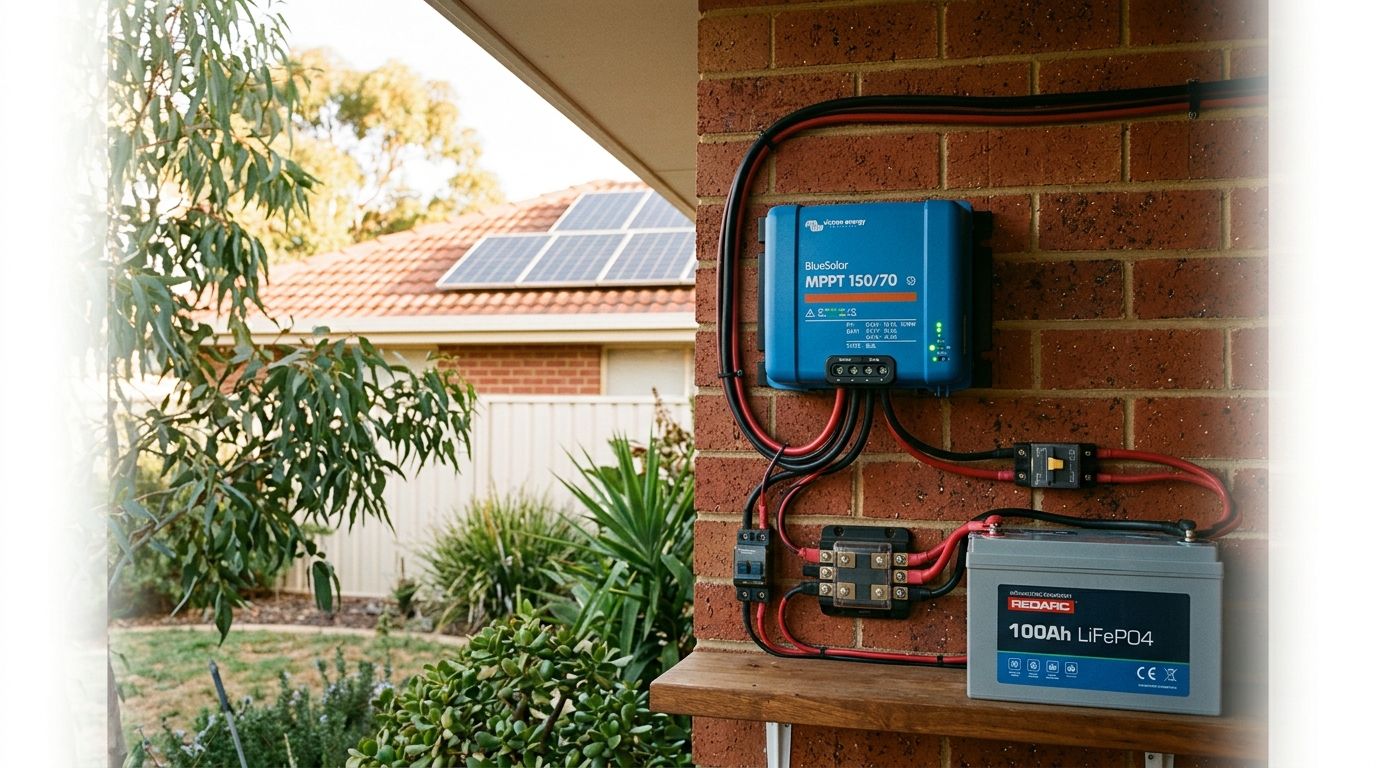
An MPPT solar charge controller is a DC-to-DC power converter that sits between your solar panel array and your battery bank. Its core job is to regulate the voltage and current coming from the panels so they match what the battery actually needs at any given moment, protecting the battery from overcharge and making sure every watt of available solar energy is put to use.
MPPT stands for Maximum Power Point Tracking. The name describes exactly what the device does: it continuously finds the precise operating point at which your panels produce the most power, then converts that power efficiently into the right charging current for your batteries.
This article covers how MPPT tracking works, how it compares to the older PWM technology, how to size a controller for your system, and whether you actually need one given your setup and location in Adelaide.
How Does an MPPT Solar Charge Controller Work?
A solar panel does not produce a fixed output. Its voltage and current vary constantly depending on sunlight intensity, temperature and shading. At any moment there is one specific voltage at which the panel generates its maximum power output, known as the maximum power point (or Vmp). An MPPT controller samples the panel's output many times per second and adjusts its internal operating point to keep the panel working at that sweet spot.
The practical result is that the controller extracts the highest possible power from the array under whatever conditions exist right now, whether that is full midday sun, a cool morning start-up, or broken cloud cover. It then converts that power into the correct charging voltage and current for the battery bank.
In Adelaide, the variable spring and autumn weather means panels frequently operate below their rated conditions. On a partly cloudy October afternoon, an MPPT controller will keep chasing the shifting maximum power point as clouds pass, recovering energy that a simpler controller would simply miss.
MPPT vs PWM: What's the Difference?
PWM stands for Pulse Width Modulation. A PWM controller works by directly connecting the panel to the battery and rapidly switching the connection on and off to control charging. The problem is that this forces the panel to operate at the battery's voltage, which is almost always lower than the panel's Vmp. Any voltage above the battery level is simply lost as heat rather than converted into useful charging current.
MPPT controllers avoid this waste entirely. Because they include a DC-to-DC conversion stage, they can accept a higher panel voltage, extract maximum power at that voltage, and then step it down to deliver more current to the battery. The result is typically 20 to 30% more energy delivered to the battery compared with a PWM controller, and the gap widens further in cool morning conditions when panel voltage is at its highest.
Here is a direct comparison of the two technologies:
- Efficiency: MPPT controllers typically achieve 93 to 99% conversion efficiency. PWM controllers sit at 70 to 80% under real-world conditions.
- Cost: MPPT controllers cost more upfront, often two to three times the price of an equivalent PWM unit. The extra cost is usually recovered quickly through better energy harvest.
- Panel voltage flexibility: MPPT controllers accept a wide range of panel voltages, so you can wire panels in series for higher array voltages. PWM controllers require the panel voltage to closely match the battery voltage, which limits your panel configuration options.
- Best use cases: PWM suits very small, simple 12V systems such as a caravan with one or two panels or a small garden shed light. MPPT is the right choice for any serious off-grid setup, a residential battery system or any installation with more than a couple of panels.
If you are running a grid-connected system with a battery, note that most modern setups use a hybrid inverter rather than a standalone charge controller. Hybrid inverters handle both the grid connection and battery charging in a single unit, so a separate MPPT charge controller is generally only needed in true off-grid or standalone battery configurations.
Key Ratings to Understand: Amps and Volts
Every MPPT controller has two primary ratings you need to match to your system. The first is the maximum input voltage, expressed in volts. This must be higher than the open-circuit voltage (Voc) of your panel array under the coldest expected conditions, because Voc rises as temperature drops. Exceeding the controller's rated input voltage, even briefly, can permanently destroy the unit. Always leave a safety margin of at least 20% above your calculated array Voc.
The second rating is the maximum output current in amps. This determines how much charging power can flow to the battery. To find the maximum solar array size a controller can handle, multiply its amp rating by the battery bank voltage. For example, a 40A MPPT controller on a 24V battery bank can handle roughly 960W of solar panels (40A x 24V = 960W). Connecting a larger array will not damage the controller, but any power above its rated output will simply be clipped and wasted, so it pays to size correctly from the start.
Common controller sizes in the Australian market include the Victron Energy SmartSolar MPPT range (models such as the 100/30, 150/60 and 250/100), which covers the 30A to 100A output range and is well regarded for build quality and built-in Bluetooth monitoring. For smaller off-grid setups like caravans and garden sheds, the Renogy Rover MPPT controllers in 20A and 40A versions offer a budget-friendly entry point. The EPever Tracer MPPT series in 40A and 60A models sits in the mid-range and is commonly used across Australian rural and off-grid residential installations.
How to Size an MPPT Solar Charge Controller
Sizing an MPPT controller correctly comes down to four straightforward steps. Get these right and your system will charge efficiently without risking damage to the controller or your battery bank.
Step 1: Add up your total panel wattage. This is simply the sum of all panels in your array. Four 400W panels give you 1,600W total.
Step 2: Divide by your battery bank voltage. Divide the total wattage by the nominal battery voltage to find the required output current in amps. For a 48V battery bank: 1,600W divided by 48V equals approximately 33A.
Step 3: Add a 25% safety buffer. Multiply your calculated current by 1.25 to account for real-world conditions where panels can briefly exceed their rated output on cool, bright days. In this example, 33A multiplied by 1.25 gives 41.25A, so a 40A or 60A controller is the right fit.
Step 4: Check the array's open-circuit voltage (Voc). Add up the Voc of all panels wired in series and confirm it sits below the controller's maximum input voltage rating, with at least a 20% margin to spare. Adelaide's summer heat actually lowers Voc, but a cold winter morning can push it higher than you expect, so always check both extremes. A qualified installer should verify this calculation before you finalise the design.
If you are planning a full off-grid setup, explore off-grid solar solutions in Adelaide to see how Best Solar & Batteries can design and install a system sized correctly from the ground up.
Common MPPT Controller Sizes and What They Suit
MPPT controllers are available in a range of output current ratings, and the right size depends on how much solar you are running and what you are powering.
- 20 to 30A: Suited to small cabins, caravans and single-panel setups. The Renogy Rover 20A and 40A models are a popular, budget-friendly choice for these applications, handling smaller arrays without the cost of a larger unit.
- 40 to 60A: The most common range for mid-size off-grid homes, rural sheds and setups with one to three kilowatts of panels. The EPever Tracer series in 40A and 60A models is widely used across Australian rural and off-grid residential installations at a competitive mid-range price point. Victron Energy's SmartSolar MPPT 150/60 also sits in this tier and adds built-in Bluetooth monitoring for easy system oversight.
- 80 to 100A: Required for larger off-grid homes or commercial setups running 3kW or more of panels. The Victron Energy SmartSolar MPPT 250/100 is a leading option here, offering a 250V maximum input voltage and 100A output, making it suitable for large series-wired arrays on 48V battery banks.
All three brands, Victron Energy, Renogy and EPever, are readily available through Australian suppliers and carry the certifications needed for compliant installations in South Australia.
Do You Need an MPPT Solar Charge Controller for Your Adelaide Home?
For most Adelaide homeowners with a grid-connected solar system, the short answer is no. A standalone MPPT charge controller is not part of a typical rooftop solar installation. Your inverter, whether a string inverter or a hybrid inverter, already handles the job of converting panel output into usable power and managing battery charging where a battery is present.
Modern hybrid inverters from brands such as Sungrow and GoodWe have MPPT tracking built directly into the unit. When you add a battery to a grid-connected home, the hybrid inverter manages the entire process: tracking maximum power from the panels, converting it for household use, charging the battery and exporting surplus to the grid. There is no need for a separate controller sitting between the panels and the battery. For Adelaide homeowners exploring battery options, residential battery storage systems are designed around this integrated approach from the start.
If you want to compare specific battery products that use this integrated MPPT design, the best solar battery options for SA homes covers the leading models available in South Australia right now.
A standalone MPPT charge controller is needed by anyone operating outside the grid-connected model:
- Rural and remote SA properties without grid access, where a standalone solar and battery system is the only power source. SA Power Networks connection costs in regional areas can run into tens of thousands of dollars, making off-grid systems a genuinely cost-effective alternative.
- Caravans and camping setups running a 12V or 24V battery bank charged by rooftop or portable panels.
- Standalone battery systems for sheds, workshops or irrigation pumps that are not connected to the main household switchboard.
- Backup power systems built around a battery bank that charges from a dedicated panel array rather than through a grid-tied inverter.
South Australia's high electricity prices, which sit among the highest in the country, have pushed more rural property owners to seriously consider going fully off-grid rather than paying for a grid connection that may cost more than the solar system itself. If that describes your situation, a correctly sized MPPT controller is a core part of the solution.
Ready to Build the Right Solar Setup for Your Property?
MPPT solar charge controllers are efficient, reliable components that sit at the heart of any well-designed off-grid or standalone battery system. They outperform PWM controllers in almost every real-world scenario, and sizing them correctly is critical to both system safety and long-term performance.
For most Adelaide homeowners on the grid, a hybrid inverter with built-in MPPT tracking is the right path. There is no need for a separate controller when a quality hybrid inverter handles everything in one unit. For rural and off-grid customers, a standalone MPPT controller from a trusted brand such as Victron Energy, EPever or Renogy is a core part of any properly designed system.
Whether you are planning a full off-grid build on a rural SA property or adding battery storage to your existing grid-connected home, the team at Best Solar & Batteries can design a system that is correctly sized, compliant and built to perform in Adelaide conditions. Get a free solar quote and we will walk you through the right setup for your property.
Frequently Asked Questions
What is a MPPT solar charge controller?
An MPPT solar charge controller is a device that regulates the flow of power from solar panels to a battery bank by continuously tracking the panel's maximum power point. Unlike a basic PWM controller, it converts excess panel voltage into additional charging current, making it significantly more efficient, particularly when panel voltage is well above battery voltage. MPPT controllers are used in off-grid and standalone battery systems, not in standard grid-connected solar setups.
What size MPPT controller do I need for a 400W solar panel?
For a single 400W solar panel, the right controller size depends on your battery voltage. Divide the panel wattage by battery voltage to get the base amperage: 400W divided by 12V equals 33A, or divided by 24V equals 16.7A. Add a 25% safety buffer, which means a 40A controller is the recommended minimum for a 12V system. Also confirm that the panel's open-circuit voltage (Voc) does not exceed the controller's maximum input voltage rating.
Can a MPPT solar controller charge a lithium battery?
Yes, most modern MPPT controllers support lithium battery charging profiles, including LiFePO4, but the controller must be configured with the correct charge voltage settings for your specific battery. Using the wrong voltage profile can damage the battery or shorten its lifespan considerably. Check the controller's compatibility list before purchasing and, where possible, choose a controller and battery from the same ecosystem or get advice from a qualified installer.
What are the downsides of using an MPPT charge controller?
MPPT controllers cost significantly more than PWM equivalents, often two to three times the price for the same amp rating, and their added complexity means more components that could potentially fail. They also require correct sizing and configuration to deliver their efficiency advantage. For very small 12V systems where panel and battery voltages are closely matched, the extra cost may not be justified. For any system above around 200W or using higher-voltage panels, the efficiency gains typically outweigh the upfront price difference.


